Day Skipper Theory vs Practical
There is a moment familiar to anyone who has sat the RYA Day Skipper theory exam - the one where you stare at a chartwork problem involving a tidal vector, a leeway correction and a vessel bearing down from the north-east, and you wonder, quite reasonably, whether any of this will ever make sense on an actual boat. The answer, as it turns out, is yes. But getting there requires understanding what each half of the Day Skipper qualification actually involves, and how the two parts fit together.
Whether you are exploring day skipper theory online from a kitchen table in January or weighing up a week afloat in Palma this summer, this guide will help you navigate the path clearly.
What Does RYA Day Skipper Theory Cover?
The Day Skipper theory course is the academic backbone of the qualification. It covers the knowledge a skipper needs to plan and execute a coastal passage safely - not just in fair weather, but when things get complicated.
The syllabus includes chartwork and position fixing, tidal calculations, passage planning, meteorology, collision regulations (the COLREGS), safety and emergency procedures, and an introduction to navigation instruments. By the end of the course, you should be able to plot a course, account for tidal streams and leeway, read a weather forecast with genuine comprehension, and understand the legal framework governing vessels at sea.
It is, in short, the thinking side of sailing. No sails are trimmed. No lines are coiled. But the understanding you build here underpins every decision you will make once you are on the water.
For a broader view of where this qualification sits within the RYA ladder, [Which RYA Course Is Right for You?] (Which RYA Course Is Right for You?) is worth reading before you commit to anything.
It is important that students complete the course and final exam before starting the Day Skipper practical course.
What Happens on the Day Skipper Practical Course?
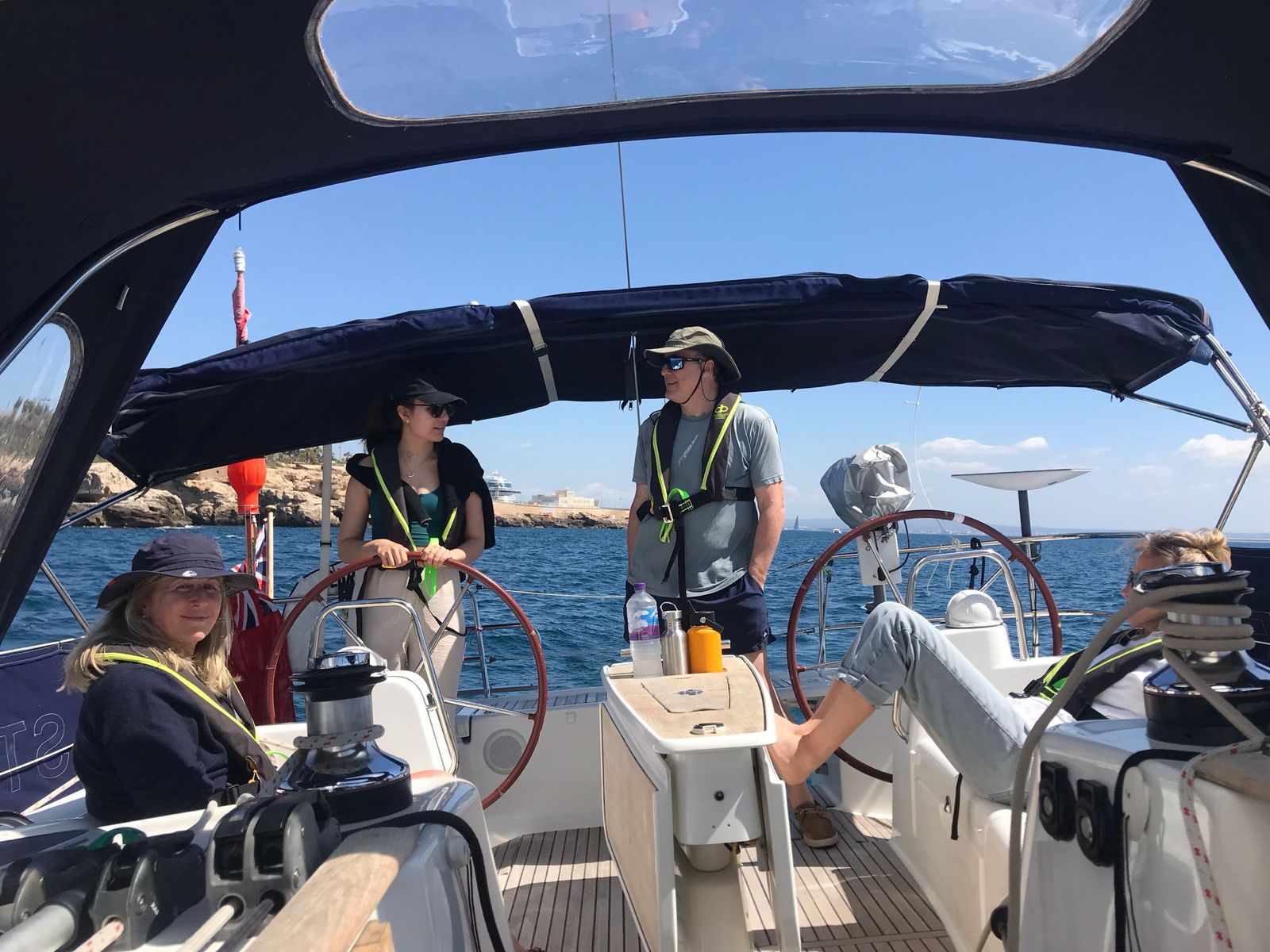
If theory is the map, practical is the territory. The RYA Day Skipper practical course takes place over five days aboard a sailing yacht, typically with an instructor and a small group (up to 5) of fellow students. You live aboard, keep watches, cook meals in a galley that moves, and gradually take on more responsibility for the boat.
The practical syllabus covers safety procedures, boat handling under sail and engine, anchoring and mooring, man overboard recovery, navigation and pilotage in coastal waters, passage planning in real conditions, and skippering the vessel for increasing periods as the week progresses. There will be a night component if the weather allows. By the final day, you are expected to be capable of taking charge - not as a solo offshore mariner, but as a competent coastal skipper who can make sound decisions and look after the people aboard.
There is no classroom here. You learn by doing, by making mistakes in a supervised environment, and by building the kind of muscle memory and situational awareness that no amount of classroom work can fully replicate. The moment you bring a yacht alongside a pontoon in a crosswind for the first time - successfully, or otherwise - teaches you something that a diagram simply cannot.
[RYA Day Skipper vs. Competent Crew] (RYA Day Skipper vs. Competent Crew) offers a useful comparison if you are still deciding which level to begin at.
Classroom vs Cockpit: Understanding the Difference
The theory and practical courses are complementary, not interchangeable. Theory gives you the framework; practical gives you the fluency. A student who arrives at the practical course with solid theoretical grounding will get considerably more, and be more likely to pass the Course, from their five days afloat - they can focus on the feel of the boat rather than struggling to recall what a spring tide means.
Conversely, a sailor who has spent years on the water but never formally studied navigation may find the theory course illuminating in ways they did not anticipate. The rules of the road, tidal calculations, and meteorological interpretation are areas where experience alone rarely fills every gap.
Can You Do Day Skipper Theory Online?
Yes - and for many people, this is the most practical way to complete it. The RYA has approved a number of providers to deliver day skipper theory online, and the format suits the course material well. Video lessons, interactive chartwork exercises and online assessments can all be completed at your own pace, fitting around work, family and the general unpredictability of life ashore.
Day skipper theory online typically covers the same syllabus as the classroom equivalent and culminates in a written exam, which may be sat at an approved centre. The quality of online provision varies between providers, so it is worth checking that your chosen course is RYA-recognised and includes tutor support - chartwork in particular benefits from being able to ask someone a question when the vectors stop making sense.
For those based in Mallorca, or planning a sailing holiday here, completing day skipper theory online before arriving means your time on the island can be spent entirely on the water. That is, by most reckonings, the better deal.
Do You Need to Do Theory Before Practical?
Strictly speaking, the RYA does not require you to complete the theory course before the practical. The two can be taken in either order, or even simultaneously if your schedule allows. The RYA requires that you display knowledge to the level of the exam, this can be gained from other qualifications such as ASA or German Sea qualifications.
In practice, however, most instructors and sailing schools - including the team here at MSA - recommend completing the theory first. Students who arrive at the practical course with a working knowledge of tidal vectors, chart symbols and passage planning simply get more from the experience.
It means the instructor concentrates on the practical instead of having to teach the theory, students can and do fail the practical due to lack of understanding on the theory. The practical week moves quickly, and time spent explaining concepts that could have been covered ashore is time not spent sailing.
[From Beginner to Day Skipper: Sarah's 12-Month Journey] (From Beginner to Day Skipper: Sarah's 12-Month Journey) illustrates this well - the sequence matters more than most people initially assume.
How Long Does Each Course Take?
The Day Skipper theory course - whether taken in a classroom or as day skipper theory online - typically requires around 40 hours of study. In a classroom setting this is usually delivered over five weekdays or a series of evening sessions across several weeks. Online, the timeline is flexible, though most students complete it within four to eight weeks depending on how much time they can dedicate each week.
The Day Skipper practical course is five days aboard, running from Monday to Friday or Saturday to Wednesday depending on the school's schedule. You will be expected to keep night watches, so arrive rested.
Which Should You Book First? Mallorca Sailing Academys Recommended Path
The honest answer is: theory first, practical second. Complete your day skipper theory online or in the classroom, sit the exam, and then book your practical course in Mallorca with the confidence that comes from knowing your chartwork is solid. You will spend less time confused and more time actually sailing - which is, after all, the point.
Then (What Does an RYA Day Skipper Qualify You to Do?) is worth reading once you are clear on the path, so you understand exactly what the qualification opens up for you.
The waters around Mallorca - the anchorages tucked behind headlands, the passages between islands, the afternoon thermals that build reliably through summer - reward the skipper who arrives prepared. Theory gives you the foundation; practical gives you the confidence to use it.
If you are ready to take the next step, enquire about Day Skipper theory or practical courses at MSA and we will help you find the right starting point for where you are now.