Galley Kit: Cooking in a Small Space
What do you actually need to feed a crew from a galley the size of a broom cupboard? Less than you think, and probably nothing you would recognise from a shore kitchen. A good boat galley kit is chosen for a moving, tilting, salt-laden environment where every item has to earn its stowage. This is a guide to what belongs aboard, how to use it without scalding yourself and how to keep it all from crashing to the sole on the first tack.
The Compact Galley
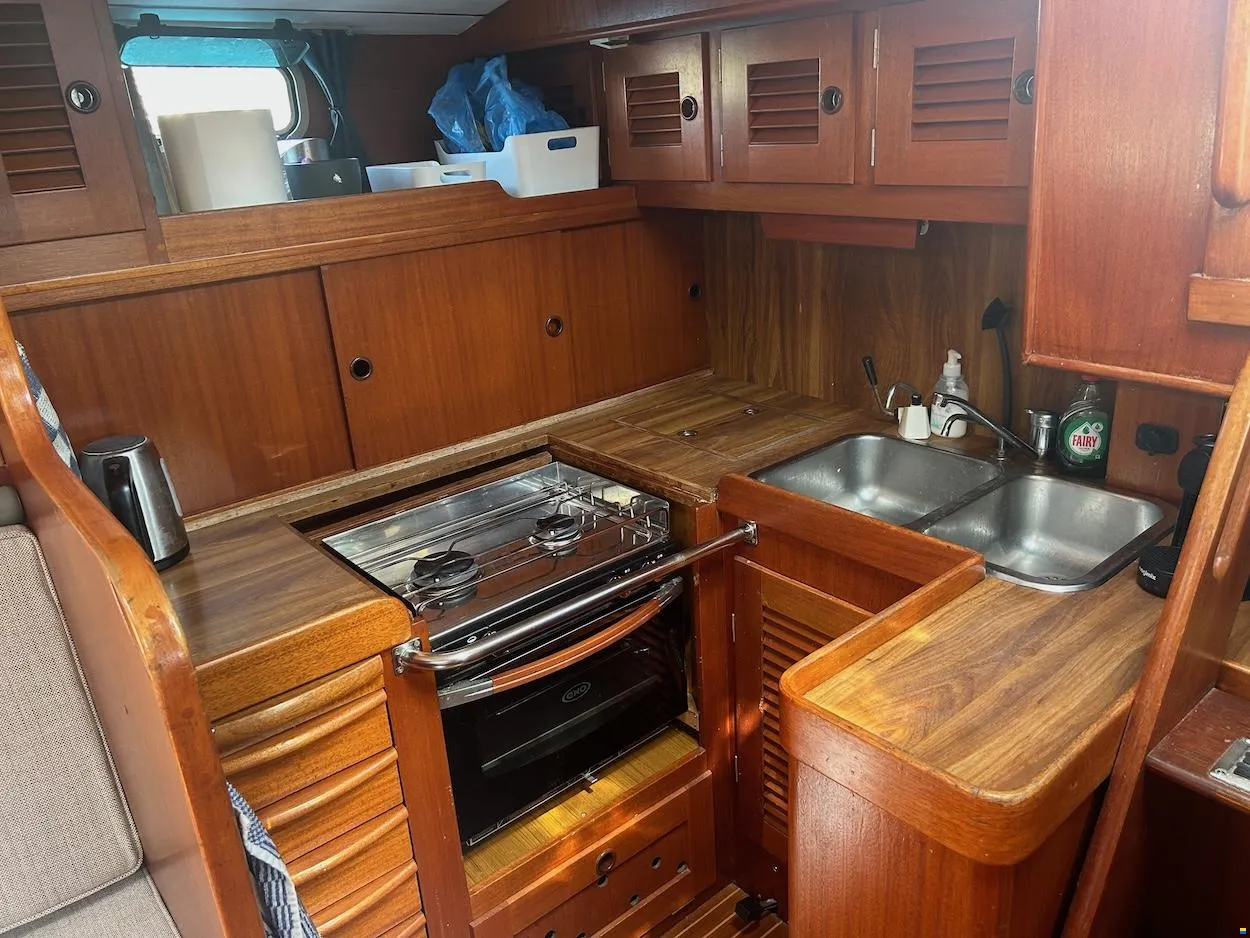
The galley on a cruising yacht is built around constraints. Space is measured in centimetres, the work surface doubles as a chart table's neighbour and everything moves. A typical layout gives you a two-burner gimballed cooker (gimballed meaning it swings to stay level as the boat heels), a small sink and a fridge or cool box tucked under a counter.
The lesson every new cook learns quickly is that you cannot spread out. Unless you are on a significant vessel there is no draining board waiting for a stack of pans, a tiny worktop for chopping while something simmers. You work in sequence, one task finished and stowed before the next begins. Once you accept that rhythm, cooking aboard becomes calm rather than chaotic.
Essential Galley Kit
A boat galley kit favours items that nest, clamp or double up. The following list covers most of what a crew of four needs for a week's cruising.
- One deep, heavy-based saucepan with a well-fitting lid. Depth matters more than width because contents slop less when the boat rolls.
- One frying pan, ideally with a lid so it can double as a second saucepan.
- A pressure cooker if you have the stowage. It cooks fast, saves gas and its locking lid means nothing escapes when you heel.
- A sharp knife and a small chopping board that fits over the sink.
- A wooden spoon, a spatula and a pair of tongs.
- Nesting mixing bowls, which stack into almost no space.
- Melamine or enamel plates and bowls rather than ceramic, which shatters.
- Insulated mugs with wide bases that resist tipping.
- A hand-cranked tin opener, because a battery-powered anything will fail at the worst moment.
- Increasingly cruisers with plenty of electric power are cooking with air-fryers, substituting for often patchy gas ovens.
Kettles are worth a thought. A whistling stovetop kettle with a low centre of gravity is safer than a tall electric one, and it works whether or not the batteries are charged.
Cooking Safely Underway
Hot liquid and a heeling boat are a poor combination, so a few habits make all the difference.
Keep the cooker gimbal free to swing and clip the pans down with the fiddle rails and pan clamps fitted for the purpose. Fill pans no more than half full so there is space for the contents to move without spilling. A pressure cooker earns its keep here too, since the sealed lid removes the risk almost entirely.
Wear proper footwear in the galley and, in any real motion, a galley strap. This is a harness that clips across your body and holds you at the cooker so both hands stay free and you are not thrown into a hot pan when the boat lurches. Long sleeves rolled down protect your forearms from splashes.
Know where the gas shut-off is and turn it off at the bottle when you finish cooking, not just at the burner. Gas is heavier than air and settles in the bilge, so this is not a detail to skip. Keep a fire blanket within reach of the cooker but not directly above it, where you would have to reach through flames to get it.
Storage Tricks
Stowage is where a well-run galley is won or lost. The principle is simple: everything has a home, and everything returns to it before it can become a missile.
Decant dry goods into square, stackable containers, which use space far better than round packets and will not split. Line lockers and shelves with non-slip matting so plates and jars stay put. Nets slung under the deckhead hold fruit and bread, keeping them off surfaces and letting air circulate.
Wine and beer bottles are best wrapped in socks or tucked into a fitted rack so they neither break nor announce every wave. Eggs keep well out of the fridge in Europe and if you turn the box daily, and heavy tins belong low down near the boat's centreline where their weight does least harm to the motion.
Dry food stores well in sealed containers, pasta and rice are staples
Think in layers. The things you reach for daily go at the front and top; the emergency tin of stew lives at the back of the deepest locker.
Cleaning and Water
Fresh water is finite aboard, so washing up is done with respect for the tank. Many crews wash in seawater and rinse in fresh, which cuts fresh-water use dramatically. A small amount of seawater-friendly, biodegradable detergent keeps what goes over the side kind to the waters you are sailing in, which around Mallorca includes the seagrass meadows that keep the bays so clear.
Wipe plates with kitchen paper before washing to reduce grease, and keep a dedicated bucket on a lanyard for hauling seawater or install a dedicated foot operated or electric sea water pump. A quick-drying microfibre cloth beats a tea towel that never dries in a humid cabin. Stow rubbish in sealed bags and take it ashore; nothing goes over the side but food scraps well offshore.
A Starter Kit List
If you are assembling a boat galley kit from scratch, this is a sensible core to build on:
- In addition to the previous recommendations
- Square stackable containers
- Non-slip matting
- Storage nets
- Galley strap
- Fire blanket
- Biodegradable detergent and a seawater bucket or clean seawater supply.
Add a bottle opener, a corkscrew and a decent set of measuring spoons and you are ready to feed a crew properly.
The truth is that a modest boat galley kit and a bit of practice will produce better meals than a shore kitchen full of gadgets, because you learn to cook with what matters and nothing else. The fastest way to learn all of this is to do it for real, at sea, with someone to show you the ropes. Live the galley life on a liveaboard RYA course with Mallorca Sailing Academy, where cooking underway is simply part of learning to run a boat well.